Month One: The Space Between Identities
Key Takeaway
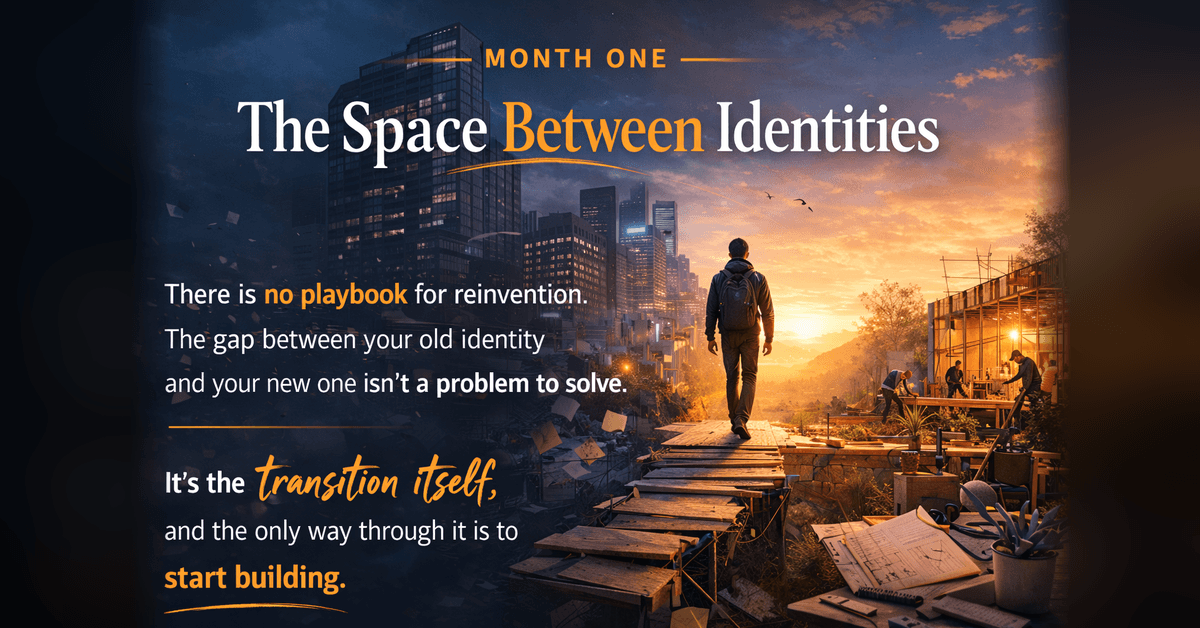
There is no playbook for reinvention. The gap between your old identity and your new one isn’t a problem to solve. It’s the transition itself, and the only way through it is to start building.
It’s been one month since I left MongoDB. People keep asking how it’s going. The honest answer is: it depends which week you’re asking about.
The First Two Weeks
I expected to feel free. Instead I felt weightless, and not in a good way. The first thing that hit me wasn’t fear or regret. It was a strange emptiness. After nearly two decades of corporate rhythm, you build an identity around the work. The meetings, the targets, the team depending on you. When all of that disappears overnight, you don’t feel liberated. You feel like someone removed the scaffolding before the building could stand on its own. There were a few days where I simply didn’t work. Not because I was tired. Because I refused to sit at my desk and grind through tasks like I was still on someone’s payroll. If the whole point of leaving was to build something that mattered, then working without genuine motivation felt like a betrayal of the decision itself. So I sat with the discomfort instead. That sounds noble when I write it now. At the time, it just felt unproductive.
The Identity Gap
Here’s what nobody tells you about leaving a senior role: socially, you become hard to categorize. In my old world, "VP at MongoDB" was a complete sentence. People understood it. They knew what it meant about your income, your status, your trajectory. Now when I tell people I quit a seven-figure job to build a solo AI startup in Italy, the reactions range from polite confusion to genuine concern. I don’t have a great answer yet. Except that the question itself reveals how narrow our definition of a valid career move has become.
The Guru Problem
During those first quiet weeks, I did what every new founder does. I consumed content. Podcasts, newsletters, Twitter threads, YouTube videos. The "quit your job and build" ecosystem is enormous. And most of it is useless. Not malicious. Just fluffy. Vague advice wrapped in motivational language. "Follow your passion." "Build in public." "Trust the process." These sound meaningful until you’re sitting alone at your desk on a Tuesday morning with no revenue, no team, and no clear path forward. Then you realize that the people giving this advice either got lucky, are selling you a course, or both. The moment of clarity came when I stopped looking for a playbook and accepted that there isn’t one. Not for what I’m building, not for how I’m building it. The frameworks that work at MongoDB don’t apply here. The advice from people who’ve never left a corporate career doesn’t apply either. The only useful input is from people who’ve actually done this, and even their experience maps imperfectly onto mine. There is no playbook. You write it as you go.
The Shift
I can’t point to a single moment where things turned. It was more like a gradient. Somewhere in week three, I stopped trying to figure out who I was now and started building. Not strategizing about building. Not reading about building. Actually building. Shipping code with my AI agents. Testing ideas against real problems. Talking to potential users. Failing at things I’d never tried before and learning from the failure instead of spiraling about it. The practice itself became the identity. Not "ex-VP figuring out his next move." Just: builder. Someone who makes things, tests them, and iterates. That shift changes everything. When your identity comes from what you’re doing today instead of what you did before, the emptiness fills itself. The motivation stops being something you search for and starts being something the work generates.
Where I Am Now
One month in, I feel more purposeful than I have in years. My life is completely different. I wake up and the first thing I think about is a problem I’m trying to solve, not a meeting I’m dreading. I’m learning faster than I have since my twenties. I’m building things that didn’t exist a week ago. I’m failing constantly and it feels productive instead of threatening. Is it harder than my old job? In every measurable way. Less money, less certainty, less social validation. No safety net, no infrastructure, no team of humans to lean on. But the work has meaning in a way that corporate life stopped providing years ago. And meaning, it turns out, is a better fuel than compensation. I’m not writing this to convince anyone to quit their job. The calculus is personal. But if you’re in that space between identities, stuck in the gap where the old you is gone and the new you hasn’t fully formed: keep going. The gap isn’t a sign that something is wrong. It’s the transition itself. You don’t skip it. You walk through it. And what’s on the other side is worth the disorientation. One month down. Everything to build.